
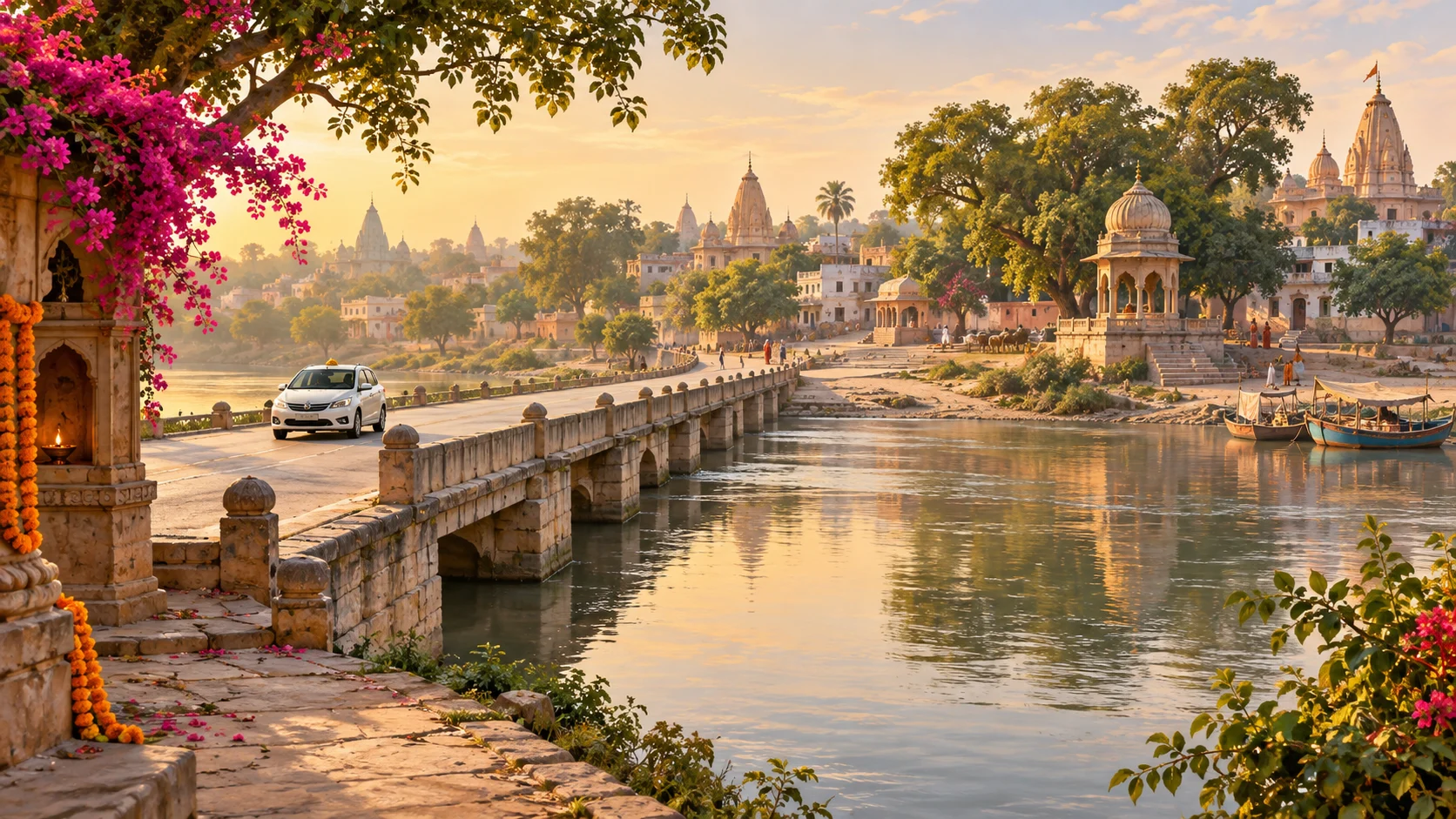
At a glance: Mathura to Gokul
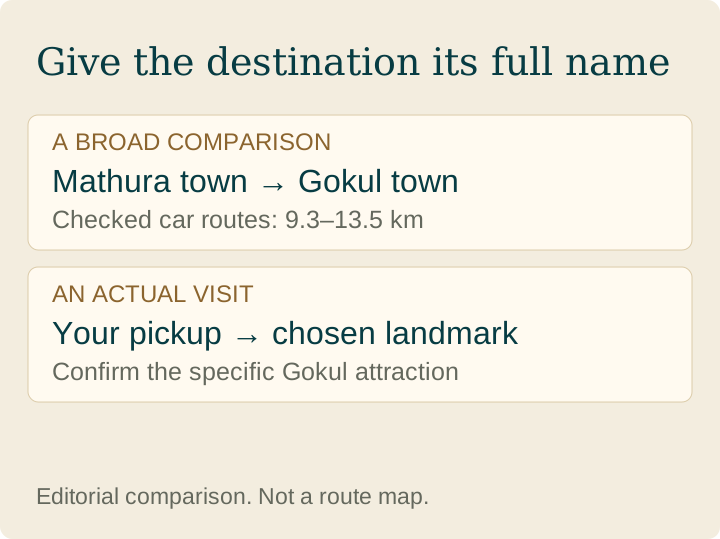
Gokul is a short road outing from Mathura, but the route and the destination deserve a little care. A broad town pin does not tell a driver whether you want Raman Reti, a particular shrine or a ghat. Choose the first place before comparing fares or deciding how many stops fit.
- The checked town car routes measured 9.3 km, 11.5 km and 13.5 km. Mathura and Gokul lie on different sides of the Yamuna, so the actual road crossing matters more than an apparent straight line.
- For Raman Reti, select the Gokul landmark explicitly. The district identifies it as a place in Gokul; do not rely on an abbreviated name or an unrelated search result.
- Allow thirty to sixty minutes for the road transfer as planning advice, check traffic and add the visits separately. Agree waiting, additional stops and the return destination before leaving Mathura.
Mathura to Gokul is roughly 9–14 km on the town-to-town car routes checked for this guide. The displayed options were 9.3 km, 11.5 km and 13.5 km. Your station, hotel and chosen Gokul landmark can change the journey, so select the actual destination rather than treating Gokul as a single temple entrance.
How far is Gokul from Mathura by road?
The checked Mathura to Gokul car routes measured 9.3 km, 11.5 km and 13.5 km. Roughly 9–14 km describes that town-to-town comparison. It does not establish the exact distance from Mathura Junction to Raman Reti or another shrine. Replace both map pins with your real starting point and first destination before booking.
Google Maps Driving mode showed these roads on 25 October 2026:
| Road reference | Distance |
|---|---|
| Mathura–Hathras Road / Agra Road | 9.3 km |
| Agra Road | 11.5 km |
| NH44 alternative | 13.5 km |
The Mathura district’s geographical description places Gokul east of the Yamuna and Mathura on the western side. Road crossings therefore matter. Do not replace a driving route with a straight-line measurement across the river, or assume every nearby bridge or lane suits the chosen vehicle.
These figures are a dated planning reference, not a report of a personally driven trip. Ask the driver to confirm the route and final arrival point for your date. A different station exit or a specific attraction can change a short journey noticeably.
Which Gokul destination should you enter?
Enter the actual attraction, including Gokul in the place name, rather than using the town as the final instruction. Raman Reti is one clear choice identified by the district. If you want a ghat or another shrine, name that instead and confirm its vehicle drop-off, remaining approach and current visiting arrangements.
The district’s Raman Reti profile describes a sacred sandy setting in Gokul. That identifies the attraction; it does not make every similar search result correct. Before departure, show the driver the complete landmark and check that both of you mean the same location.
The district’s wider circuit guide also discusses Brahmand Ghat and the Gokul–Mahavan area. Treat named stops individually. A route to the town is not a measured road distance between all of them, and a one-way fare should not be assumed to include a local sightseeing circuit.
Start with one main place and ask what the group wants from the visit: darshan, time at a sacred site or a broader introduction to the area. Our Gokul introduction supplies context. Devotional stories explain why the places matter; they are not dated archaeological evidence or confirmation of today’s access conditions.
Keep a screenshot of the full address available if mobile reception becomes inconvenient.
For the return, our Gokul to Mathura guide distinguishes a city arrival from a timed transfer to the correct railway station.
How much time and transport should you plan?
Use thirty to sixty minutes as an initial road-transfer allowance, then check current traffic and the actual crossing. That is our planning advice, not a measured driving range. Add time for the first attraction, any onward stops and the return. A short distance does not mean the whole outing fits inside an hour.
If arriving by train, arrange pickup after allowing for leaving the platform, collecting your group and finding the vehicle. Keep Mathura Junction’s station code, MTJ, visible on the booking. For dated train details use IRCTC; this guide does not verify a current service or ticket.
Ask a taxi or auto driver for a quote covering your actual stop list and waiting. If using a bus or shared ride, check the boarding point, arrival stop and any further connection. No fixed local fare or guaranteed service frequency is established here.
Carry water and keep a clear return meeting point. If part of your group wants a shorter visit, agree how that works before separating. Where the day continues to Vrindavan, our Gokul to Vrindavan guide covers the separate onward transfer. Do not use the Mathura distance as a shortcut for that journey.
Frequently asked questions
What is the Mathura to Gokul distance?
Roughly 9–14 km on the checked town-to-town car routes. The displayed distances were 9.3 km, 11.5 km and 13.5 km.
Is the town distance also the distance to Raman Reti?
Not necessarily. The comparison uses named town endpoints. Enter your actual Mathura address and the Raman Reti Gokul landmark for a specific journey.
Why does the river affect a short trip?
The district places Gokul and Mathura on different sides of the Yamuna. Use the actual road crossing and vehicle route rather than a straight-line estimate.
Can I use a boat instead of the road?
This guide does not establish an operating passenger-boat transfer. Do not plan an essential connection around a boat service that you have not independently confirmed.
Can I see several Gokul places in one booking?
Ask for the named stops, waiting and return to be included explicitly. A single town drop-off does not automatically cover travel between attractions.
Choose the Gokul place you most want to understand, give it time, then decide whether another stop still fits comfortably.