
At a glance: plan your Prem Mandir visit
Plan Prem Mandir around the experience your family actually wants. Morning worship, evening architecture and the musical fountain have different requirements. The strongest plan leaves room for the approach and return instead of treating the show’s start time as your arrival time.
- Darshan: Use the temple’s published visitor timetable and check special notices for your date. Do not assume that an early ritual time copied elsewhere is the ordinary public opening.
- Evening: Distinguish the coloured temple lighting from the scheduled fountain performance. Protect time for worship first, then select a comfortable viewing position without blocking circulation.
- Family: Confirm the actual drop-off, walking needs, hotel approach and return pickup. General admission is listed as free; transport, accommodation and optional purchases belong in a separate budget. This guide records published information checked on 29 October 2026 and labels its example plan as editorial advice.
Prem Mandir Vrindavan is a white-marble temple dedicated to Shri Radha Krishna and Shri Sita Ram. Its published opening hours are 8:30 am–noon and 4:30–8:30 pm. For a first visit, choose between morning darshan and an evening combining worship, illuminated architecture and the seasonal musical fountain.
What is special about Prem Mandir?
Prem Mandir brings devotional worship, carved storytelling and an evening garden visit together. It suits a traveller who wants to understand the scenes as well as see the illuminated marble. Give the temple a place in your day that allows both, rather than arriving only for a quick photograph.
The Mathura district profile identifies Jagadguru Kripalu Parishat as the organisation maintaining the temple. The name means Temple of Divine Love. It reflects the devotional purpose of the complex, so the lighting should be understood as one part of a working place of worship.
For an Indian family making its first Braj trip, the useful question is what everyone hopes to experience. A grandparent may prioritise darshan, a child may enjoy identifying Krishna’s stories, and someone interested in architecture may want daylight. Discuss those wishes before choosing your arrival slot.
Our recommendation is simple: decide the main purpose first, then add the evening show if it fits. Reserve roughly two to three hours as an editorial starting point, with extra time if your family needs a slower pace.


What are Prem Mandir Vrindavan timings?
The temple’s official visitor timetable, checked on 29 October 2026, gives two daily opening windows: 8:30 am–12 noon and 4:30 pm–8:30 pm. The gap between them matters when planning your arrival. Recheck notices before travelling, especially if you want a particular ritual or are visiting for a festival.
| Time | Listed activity |
|---|---|
| 8:30 am | Darshan and aarti |
| 11:30 am | Bhog |
| 12 noon | Shayan aarti; doors close |
| 4:30 pm | Aarti and darshan |
| 5:30 pm | Bhog |
| 7 pm | Parikrama |
| 8:10 pm | Shayan aarti |
| 8:30 pm | Doors close |
Darshan is the devotional encounter with the deity; aarti is worship with light, and bhog refers to a food offering. These terms describe activities, not a promise that every visitor can enter at the last minute.
If you want morning worship, leave time to reach the building before the session ends. If your train reaches Mathura around lunchtime, use the closure for your transfer, check-in and meal. Waiting outside for several hours is rarely the best introduction to Vrindavan.
The downloadable schedule reference records the source and checking date. Keep its link with your trip notes and review the original notice again before departure.
Leave any additional shopping until afterwards.

What time is the Prem Mandir light and fountain show?
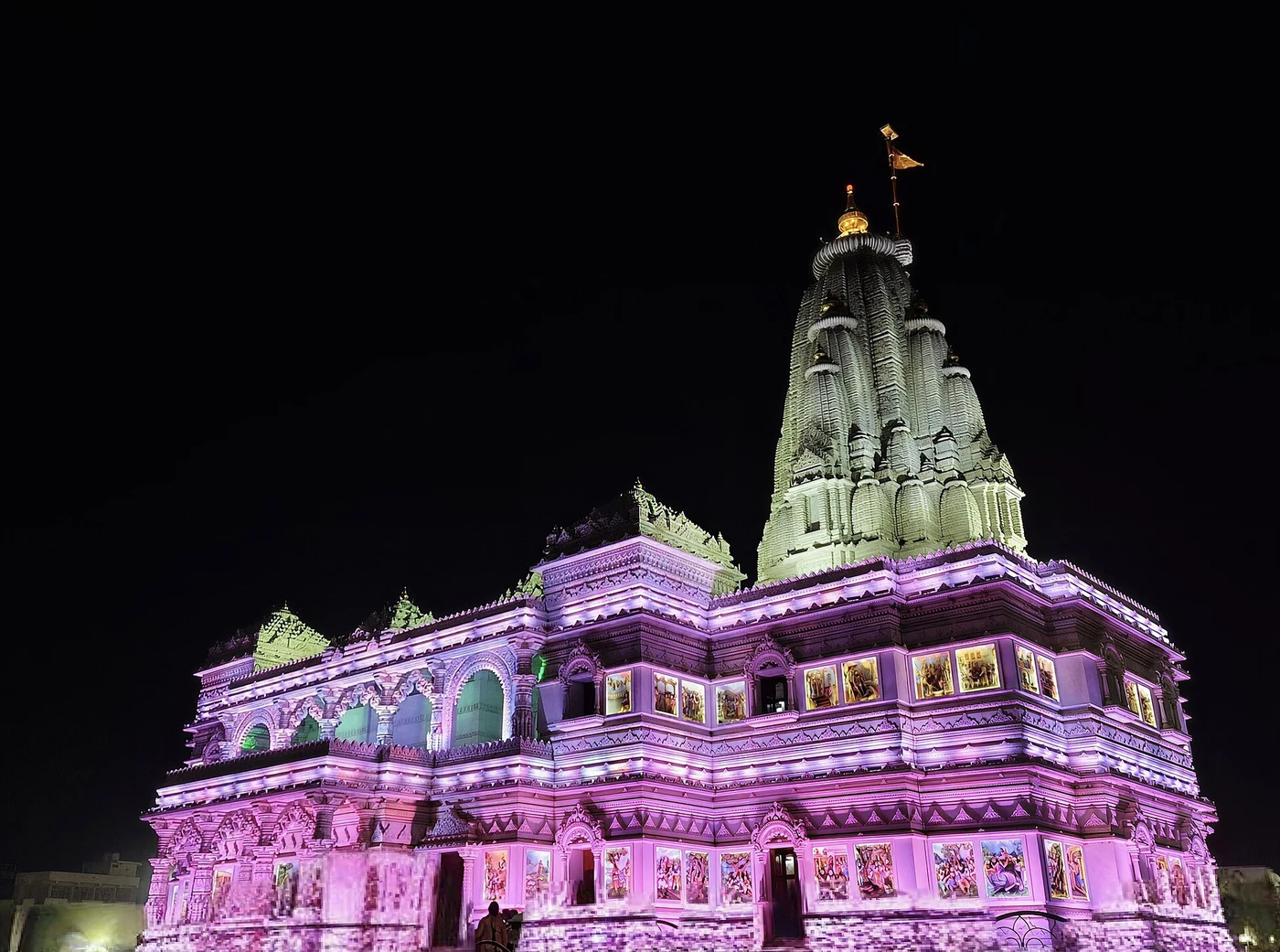
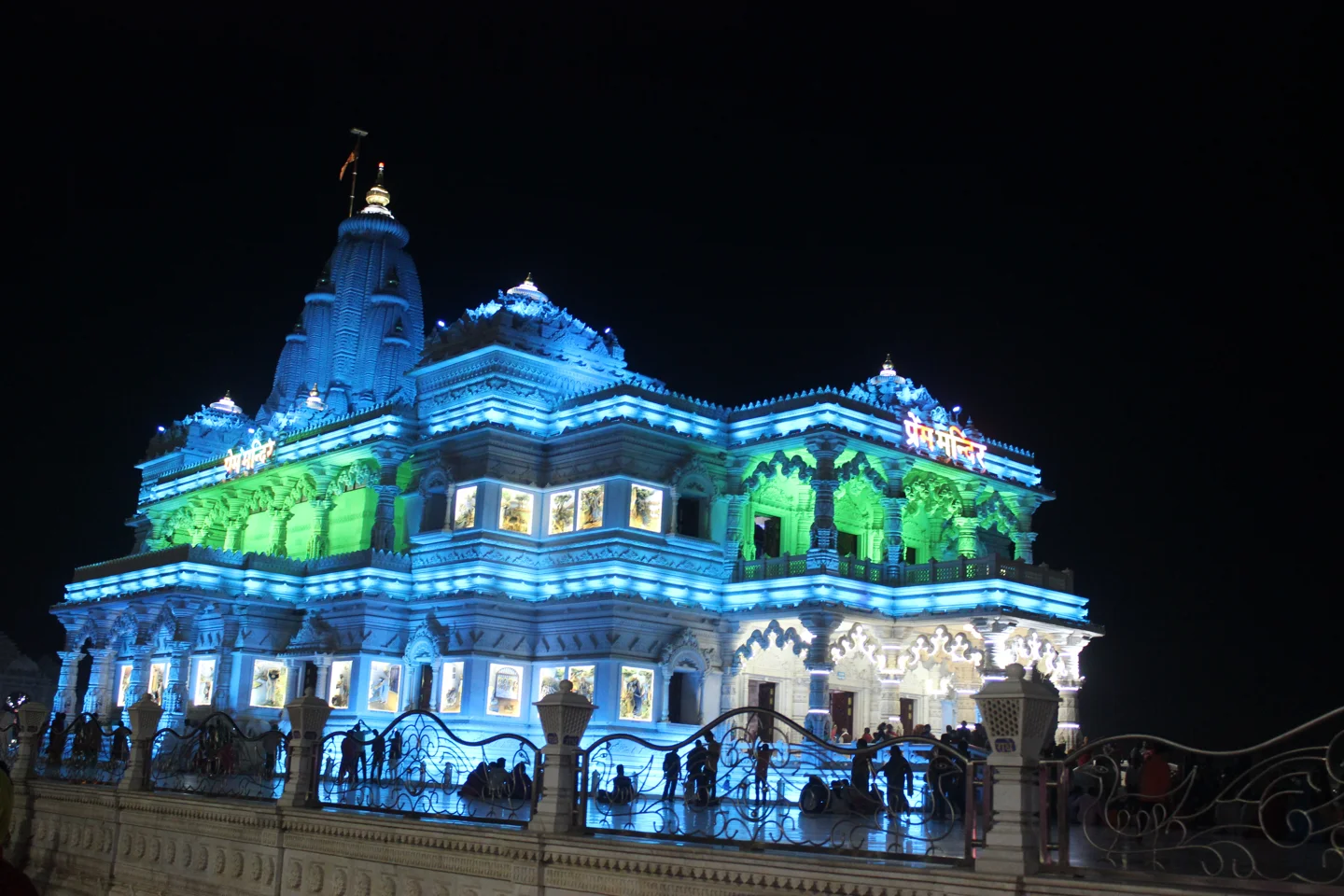
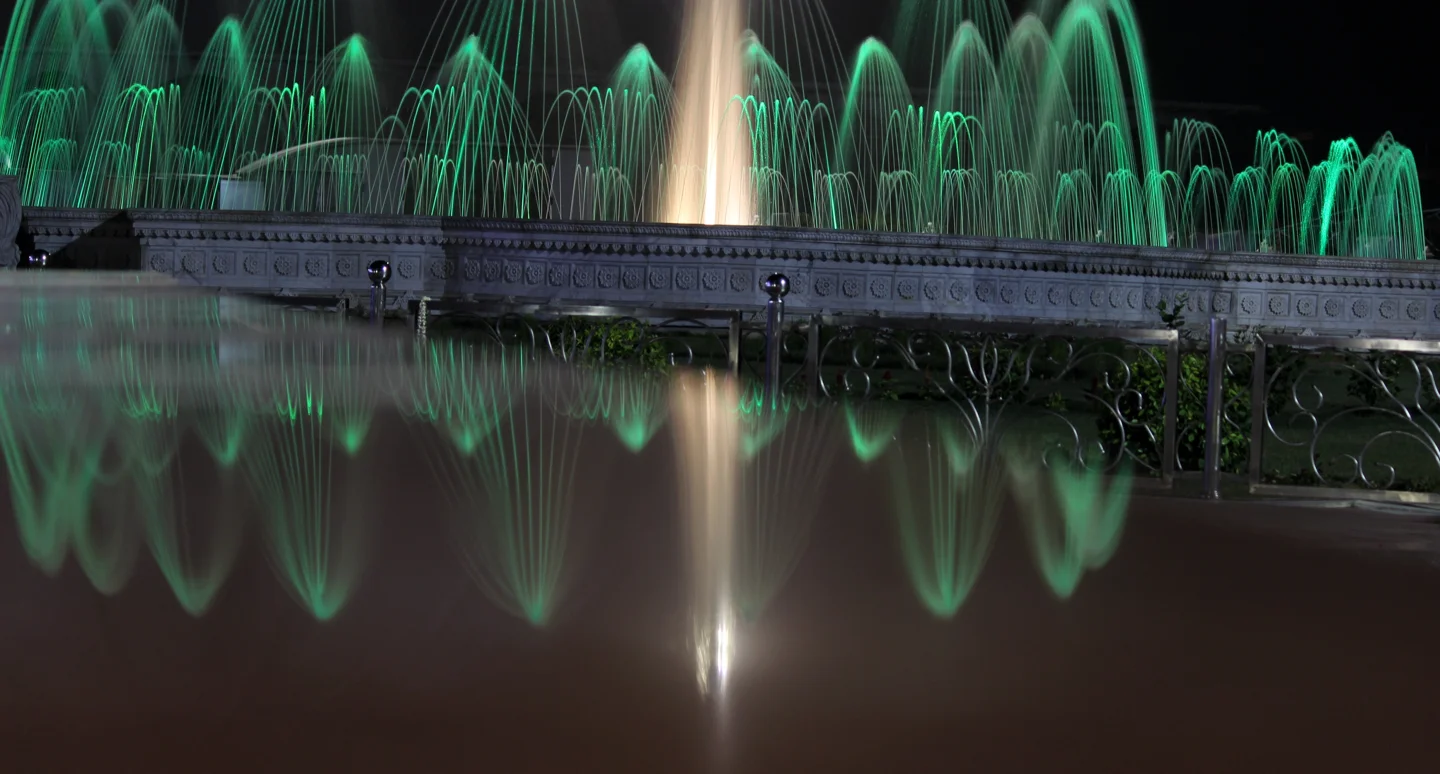
The musical fountain is a scheduled performance; coloured lighting on the marble is a separate visual experience. The temple lists the fountain for 7–7:30 pm from October to March, and 7:30–8 pm from April to September. Check the current notice before arranging your evening around the performance.
Visitors often call everything the Prem Mandir light show. That phrase can blur three different things: seeing the illuminated building, watching the fountain, and attending an evening worship activity. Decide which matters to you so that one does not accidentally displace another.
Our preference for a first evening is to arrive while there is still daylight, take darshan, look at the exterior, and then watch the fountain if the programme is running. Daylight and sunset vary through the year, so one universal arrival time cannot deliver the same sequence in every season.
The official page does not specify a separate fixed switch-on time for the coloured building lights. We therefore avoid presenting a precise lighting time as a verified daily rule. The published seasonal fountain slot is the firmer reference.
Choose a position where your group can remain together without obstructing a pathway. If someone becomes tired or the viewing area is uncomfortable, skip the performance and keep the main temple visit. A good visit need not include every part of the evening.

Is Prem Mandir entry free, and do you need tickets?
General admission is listed as free in the temple’s Google Maps admission panel, checked on 29 October 2026. Treat paid transport, guided tours, hotel packages and optional purchases as separate services. A commercial listing that includes Prem Mandir does not by itself mean the temple requires a paid admission pass.
The place listing identifies the admission offer with the official site. The temple’s own timetable does not advertise a separate fountain-ticket purchase. If someone offers an extra pass, ask temple staff what it covers before paying rather than assuming it is necessary for ordinary darshan.
Build a practical budget around what your family will actually use: the ride from your station or hotel, any waiting charge, meals, accommodation and your onward journey. Agree whether a vehicle quote is one-way, return or retained through several stops.
For example, a driver quoting a hotel-to-temple transfer may not be offering to wait until the show ends. Clarifying that point can matter more than comparing two small differences in the initial fare. Ask where you will meet and what happens if your visit runs later.
We do not publish a universal taxi fare, parking charge or optional-purchase price here. Those depend on the provider and current arrangements. Ask for the final amount and inclusions before confirming a service, and keep any donation separate from the practical cost of reaching the temple.

Who built Prem Mandir, and what should you see?
Prem Mandir was founded by Jagadguru Shri Kripalu Ji Maharaj. The temple’s history account dates its foundation ceremony to 14 January 2001 and consecration ceremonies to 15–17 February 2012. It is a modern contribution to Braj’s devotional landscape, with a visual language that helps visitors follow sacred stories.
According to its architecture page, the building uses white Italian Carrara marble, and the outer walls carry 84 panels depicting Shri Radha Krishna’s pastimes. Treat the exterior walk as time to read those scenes, rather than simply a route between the entrance and a photograph.
The temple’s own introduction describes garden depictions of Jhulan, Govardhan, Raas and Kaliya Naag leelas. A leela is a divine pastime in devotional tradition. With children, choose one scene and explain its characters before trying to see them all.
A useful order is worship first, one attentive exterior circuit next, and selected garden scenes afterwards. This is our editorial recommendation, not a compulsory route or a claim that every area will be accessible on your date.
Pause for the carved detail and inscriptions where circulation permits. Read the site’s own interpretation alongside what you see; it adds more to the visit than memorising construction statistics. An illuminated photograph is striking, but understanding the story gives it a context you can carry home.

How do you reach Prem Mandir from Mathura Junction?
Use Mathura Junction Railway Station to Prem Mandir, Vrindavan as the exact journey, rather than a generic Mathura-to-Vrindavan search. In the Driving check on 29 October 2026, displayed roads measured 12.6 km and 18.2 km. The shorter option carried a restricted-usage warning, so confirm the permitted approach with your driver.
The checked car directions showed a route through the Bhuteshwar Road–Mathura–Vrindavan corridor and a longer option using NH 44 and Shri Kripalu Ji Maharaj Marg. These are dated map observations, not guaranteed road access or fixed journey times.
Check the station exit where you will meet, the vehicle’s capacity and the actual drop-off before agreeing the trip. Add time to leave the train, collect bags and reach the vehicle. The road distance does not include those tasks or your walk inside the temple grounds.
The temple’s contact page lists Jagadguru Kripalu Dham, Shri Kripalu Ji Maharaj Marg, Vrindavan, Mathura, Uttar Pradesh 281121. For date-specific questions, its published number is +91 88824 80000. Save the correct temple pin with your hotel address.
For Delhi arrivals, our Delhi to Vrindavan guide explains the broader road decision. Replace its town destination with your actual temple or hotel; do not reuse a city-distance estimate as an airport-to-gate promise.

Is morning or evening better for visiting?
Choose morning if darshan and the marble details are your main purpose. Choose evening if you also want the illuminated exterior and a chance to watch the scheduled fountain. For a family with an early onward departure, morning can be the more practical choice even when night photographs are the attraction.
For a first sightseeing-oriented visit, we favour an evening that begins before sunset and continues only as long as everyone is comfortable. It lets you compare the same building in daylight and coloured light. This is an editorial preference, not a claim that evenings are always quieter or better for every devotee.
Check your date’s weather when choosing clothing and the amount of outdoor time. In hot conditions, protect breaks and avoid building a long exposed walk into an already tiring day. In cooler weather, take a light layer for the return rather than assuming afternoon conditions will continue after dark.
Festival travel needs a different plan. A temple-owner notice dated 10 September 2026 on its place listing announced a special 3 am gate opening for Radhashtami. That historical notice demonstrates why ordinary hours cannot settle a festival visit; it is not a daily schedule or a promise for a future celebration.
If your priority is a predictable family outing, choose the date before booking the vehicle and check current instructions. If the festival itself is your purpose, make its confirmed programme the starting point.
Can elderly parents and children visit comfortably?
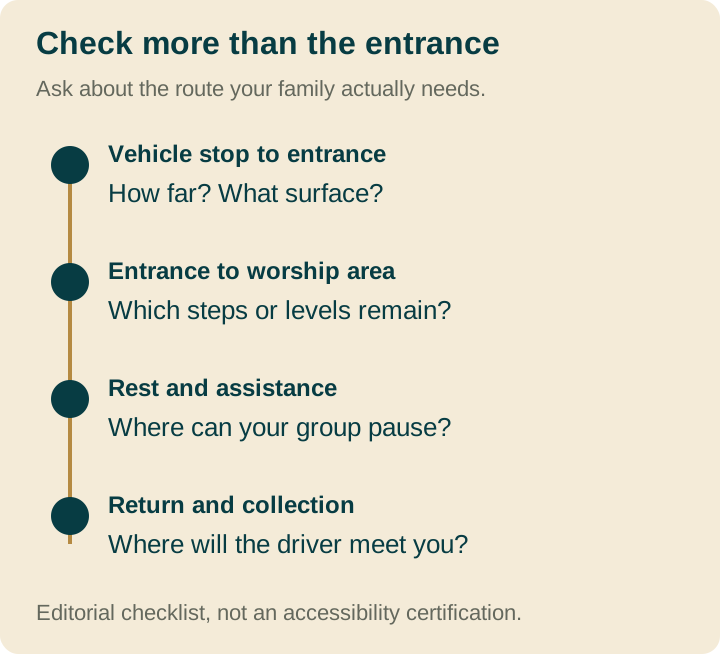
A family visit works best when the plan matches the person who needs the slowest pace. Check the vehicle stop, distance to the entrance, route to the worship area, seating and return collection before travelling. A large garden campus does not automatically mean every part of the visit is step-free.
Google Maps labels the entrance wheelchair accessible. That is useful information about the entrance, but it does not establish access to every level, wheelchair availability or assistance on your date. Contact the temple for those specific needs, including any restrictions on mobility equipment.
Ask concrete questions: can the person remain in their chair throughout the required route? What steps remain? Where can they rest? How will the group return after the show? A clear answer about one route is more useful than the general reassurance that a place is suitable for seniors.
With children, choose a meeting point and explain what to do if separated. Keep a responsible adult with anyone who needs help, including while others retrieve footwear or arrange transport. Do not make a child’s comfort depend on standing through the whole fountain performance.
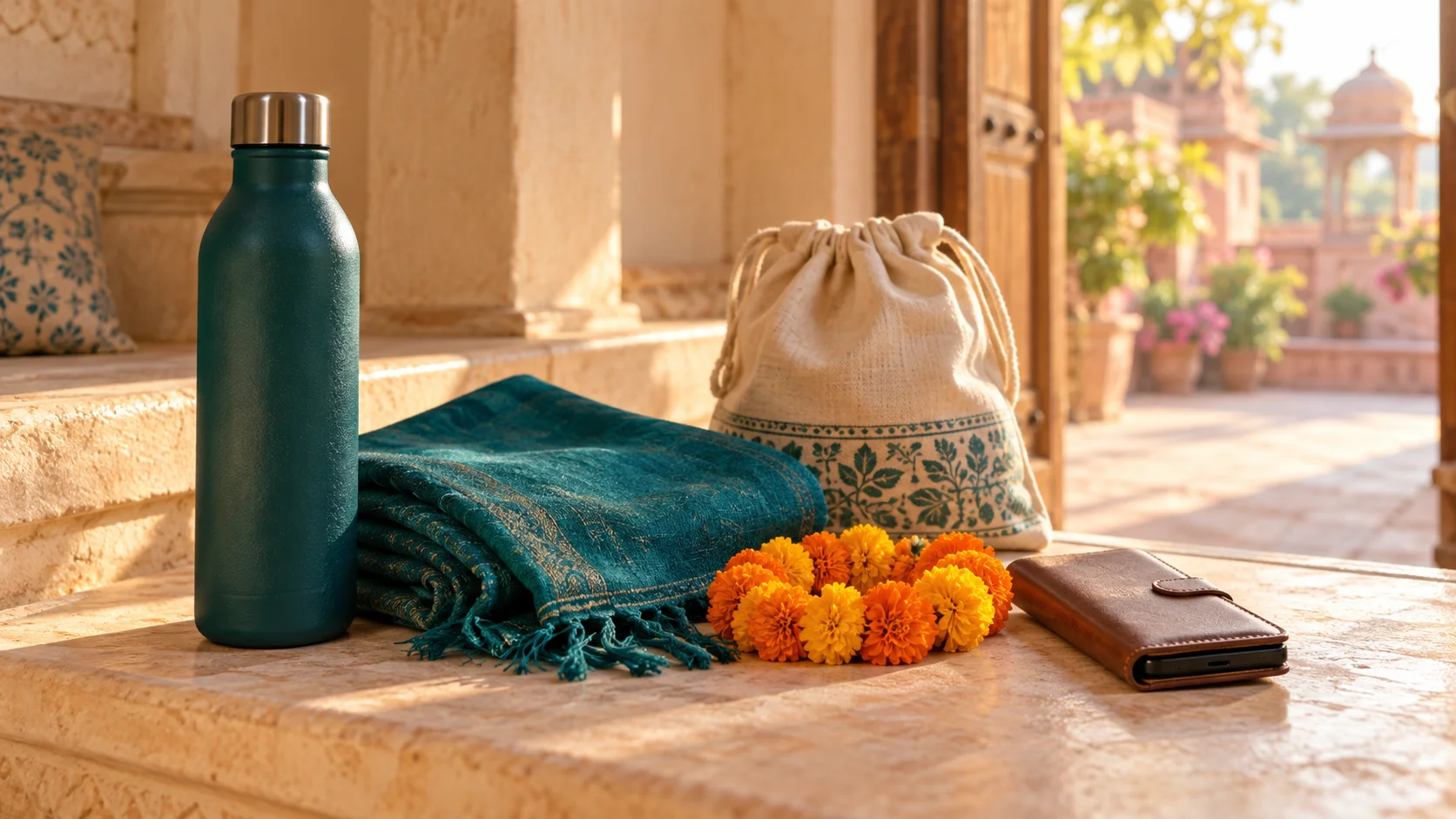
Carry a manageable amount of water and essentials, subject to current entry instructions. If the group is tired after other temples, shorten the exterior walk and protect darshan. Leave the optional part of the evening optional, so that everyone can finish the visit without feeling hurried.
How should you choose a hotel or dharamshala nearby?
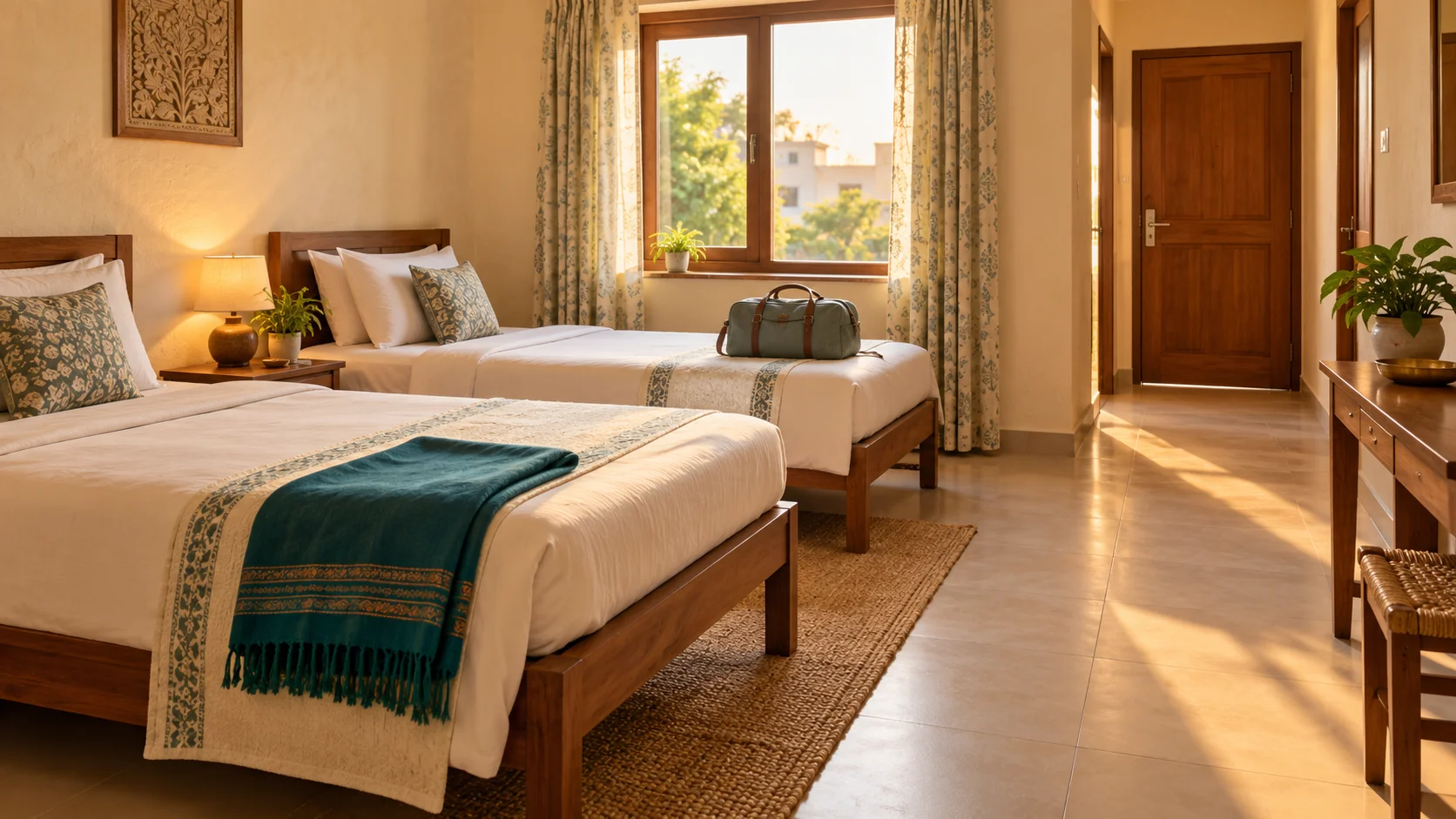
Choose a stay near Prem Mandir by its real walking or vehicle approach, room arrangements and fit with the rest of your Braj trip. A property advertising proximity may still leave a difficult final walk. Ask for the entrance pin and current room details before comparing the price or a map’s straight-line distance.
For elderly parents, confirm the floor, lift access, bathroom arrangement and route from the vehicle to the room. Ask the property to describe any remaining steps. A lift somewhere in the building does not answer whether it serves the room you are booking.
For a hotel, dharamshala or ashram, check arrival and return rules, visitor eligibility, family-room availability, meals and cancellation terms directly. Do not assume that every religious stay accepts walk-in guests or allows a late return after an evening outing.
If you arrive before the room is ready, settle luggage storage and changing arrangements. If your train leaves after checkout, clarify those needs too. The temple visit becomes easier when the family is not carrying overnight bags through the grounds.
This guide does not rank unvisited properties or attach invented nightly rates. Use recent, relevant reviews to identify questions, then get the important answers from the accommodation itself. For a trip covering Mathura, Barsana or Govardhan as well, choose a base for the whole itinerary rather than one evening’s photograph.
What is a realistic first-evening plan?
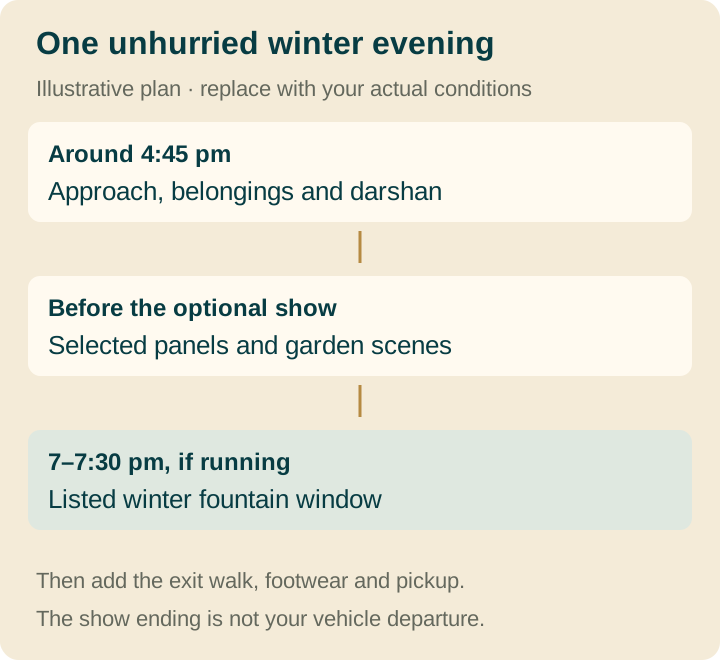
Reserve the evening for Prem Mandir, with at most one additional temple if your group is comfortable. Put darshan before optional photography and fountain viewing. Work back from your actual return commitment, then allow for the walk out and vehicle collection. The example below is editorial planning, not a measured itinerary.
Illustrative winter plan: aim to reach the approach around 4:45 pm, settle belongings and take darshan without rushing. Use the next part of the visit for selected exterior panels and garden scenes. If the listed winter fountain is running and the family wants to stay, choose a suitable viewing place ahead of it.
Afterwards, allow for reaching the exit, collecting footwear and finding the agreed pickup. A 7:30 pm show finish does not mean the vehicle can leave at 7:30 pm. Replace each allowance with conditions on the day; abandon an optional stop if the main visit takes longer.
ISKCON’s Krishna Balaram Mandir can be a separate nearby choice, but check its own programme before combining the two. Do not treat neighbouring temples as sharing one timetable.
If you also want Banke Bihari, its visitor guidance says private cars cannot reach the temple door. Plan that approach separately. For a first trip, our Vrindavan decision guide helps choose meaningful contrasts without filling the day with transfers.
What should you know about photos, food and temple etiquette?
Prem Mandir is a working place of worship, so check photography and belongings instructions at the entrance and follow staff directions inside. Ask specifically about the place where you want to take a picture. Permission to photograph an exterior should never be assumed to cover the deity, a ritual or other visitors.
For an exterior photograph, stand where people can still pass, keep the family together and avoid turning a doorway into a photo position. Give worshippers space even when a light colour or fountain sequence looks especially striking. Ask before including another person prominently in your frame.
Wear comfortable, modest clothing and footwear that is easy to remove where required. Keep track of the collection arrangement so that the end of the visit does not become a search for the right counter. Ask about larger bags before bringing them; a sightseeing plan should not depend on unverified storage facilities.
Plan food around your family’s needs. Eating before a long evening or arranging a meal afterwards may be simpler than expecting every preference to be available inside. Confirm any essential dietary requirement with the actual provider rather than relying on a general description of Vrindavan’s food.
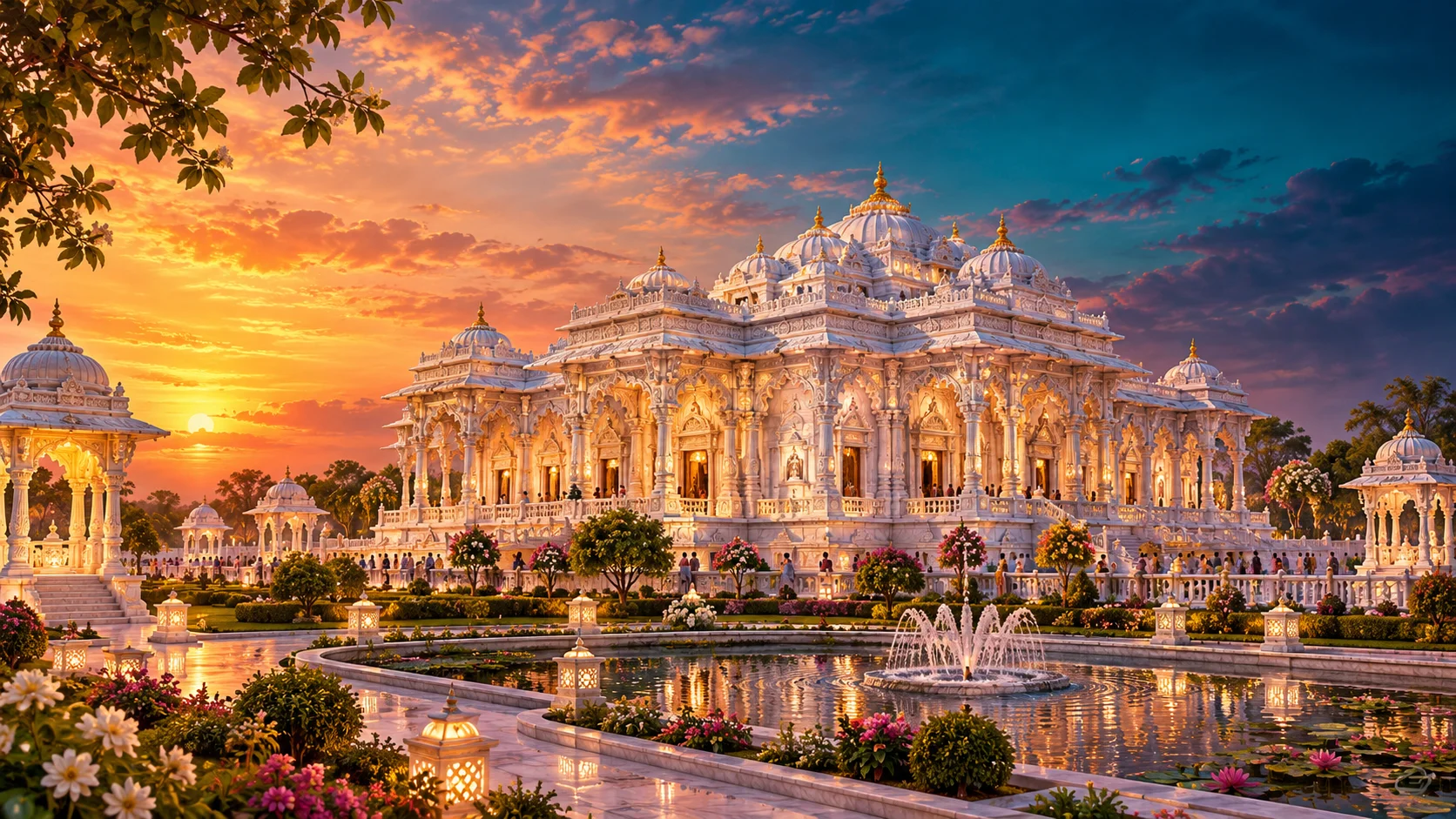
The photographs in this guide are credited historical views, not live crowd reports. The cover is AI-created artwork. Use both to understand the visual character, while relying on current temple notices for access and the day’s programme.

Frequently asked questions
Is Prem Mandir open every day?
The official site lists daily morning and evening visitor windows. Check special notices for your date, since a festival programme can change ordinary arrangements.
What is the Prem Mandir closing time?
The published doors-close times are noon and 8:30 pm. Allow for the approach and worship before closure; arriving at closing time is not a practical darshan plan.
What time is the fountain show in winter?
The temple lists 7–7:30 pm for October–March. Reconfirm the programme before travelling specifically for the show.
Do you need a paid entry ticket?
General admission is listed as free. Separate tour, vehicle or hotel charges are not proof that the temple itself requires a paid admission pass.
How long should a visit take?
Reserve roughly two to three hours as an editorial starting point. Your queue, mobility needs and chosen activities can extend the visit; keep the return approach separate.
Can you take photos inside?
Ask staff and follow the signs for each area. Outdoor photography permission does not establish permission near the deity or during worship.
Is Prem Mandir the same as Banke Bihari?
No. They are separate temples with different worship traditions and approaches. Choose and check each visit independently rather than treating one as an interchangeable stop.
Start with the visit your family wants, confirm the current programme, and leave enough time to enjoy it. Continue with our Mathura to Vrindavan travel guide when arranging the wider journey.